A Lecture of Refinement.
A Justified workshop with the University of the Arts Bournemouth

Exploring the power of strategic insight, creative thinking and finding simplicity in an age of abundance.
We live in a time where almost anything feels possible. Ideas can be generated in seconds, images imagined into existence and entire creative worlds built from a single prompt. Artificial intelligence is rapidly removing the barriers between imagination and execution, opening up extraordinary possibilities for the next generation of designers. Yet, as the tools at our disposal become more powerful, a new challenge emerges. When everything becomes possible, how do we decide what's actually worth creating?
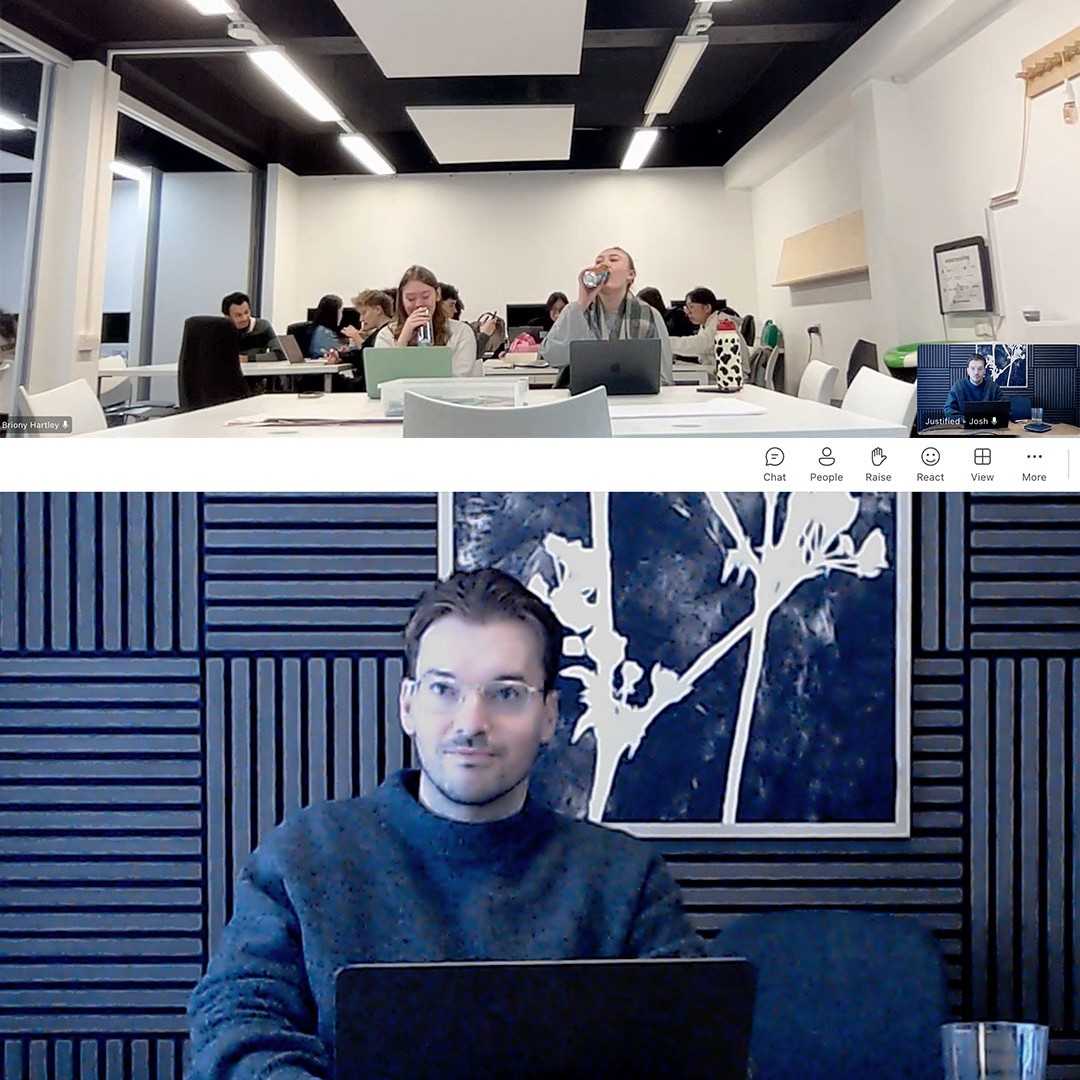
It's a question that sits at the heart of contemporary creative practice, and one that our Creative Director Joshua Ogden brought to the Visual Communication students at Arts University Bournemouth (AUB).
Through a workshop exploring the relationship between strategic insight and creative expression, Joshua challenged students to look beyond the possibilities of what they could make and consider something far more fundamental: why they should make it in the first place. Because in a world increasingly defined by abundance, perhaps our greatest creative advantage isn't the ability to produce more, but the ability to find meaning in less.
To bring this thinking into practice, Joshua introduced students to the concept of creative playbooks: a bridge between strategic thinking and creative execution. Rather than acting as rigid guidelines, these playbooks establish a clear foundation for how a brand thinks, behaves and expresses itself. They bring together audience insights, beliefs, narratives and creative principles into a shared vision, creating the freedom to explore different possibilities without losing sight of the idea at their centre.
Students were then challenged to put this approach into action by imagining a new outdoor brand for children. The brief began with a simple but compelling observation: children today are spending more time indoors, increasingly absorbed by screens and spending less time exploring the world around them. In an industry filled with outdoor brands designed for adults, what might a brand look like if its entire purpose was to inspire children to rediscover the joy of movement, curiosity and adventure?
From this insight emerged a deliberately simple mission: Get kids moving.

Working in groups, students were tasked with developing a one-page creative playbook that could bring this mission to life. They explored the audience's motivations, defined what their brand believed in and developed a narrative capable of connecting with children and parents alike. From there, they considered how those beliefs could influence the brand's personality, visual language and creative behaviour, translating strategic thinking into tangible expressions through campaign concepts, messaging and imagery.
The exercise highlighted an important distinction between making something visually interesting and creating something meaningful. A compelling brand isn't simply a collection of attractive design decisions. It's an idea with a clear purpose, expressed consistently and creatively across everything it does. By starting with a human insight rather than a visual aesthetic, students were encouraged to discover how a single, well-defined thought could open up an entire world of creative possibilities.
For the students at AUB, the creative playbook became a way of exploring this relationship. By distilling an ambitious brand proposition into a single page, they were encouraged to prioritise the essential thinking behind their ideas. Not to make the work smaller, but to make its potential greater.
As an industry, we have a responsibility to nurture this way of thinking. To encourage emerging creatives to ask better questions, challenge established perspectives and recognise that their greatest value lies not only in what they can make, but in how they see the world. The most exciting creative futures will be shaped by those willing to explore new possibilities while remaining grounded in a clear sense of purpose.
And in a world where we can create almost anything, perhaps the most important creative skill of all is knowing what's worth creating.